Advantages of Using Plastic Hybrid Aspheric Lenses
TECHSPEC® Plastic Hybrid Aspheric Lenses are low cost optical components that lack both spherical and chromatic aberrations. These aspheric lenses provide optical designers with unique, single element solutions for achieving diffraction-limited focusing performance at high numerical apertures with broadband light sources. These aspheric lenses consist of a diffractive surface that has been added to a molded aspheric lens. The aspheric lens eliminates all spherical aberration, while the diffractive surface has a net effect of introducing negative dispersion – when properly tuned to the refractive index and wavelength design of the lens, chromatic aberration is eliminated as well.
Spherical and Chromatic Aberrations
There are two major forms of axial optical aberrations inherent in common optical lenses: spherical aberration and chromatic aberration. Spherical aberration is an inherent characteristic of any lens whose surface is a section of a sphere. Light originating from the same object point comes to a focus at slightly different points (P and P’), depending on whether the rays pass through the center of the lens or the periphery (Figure 1).
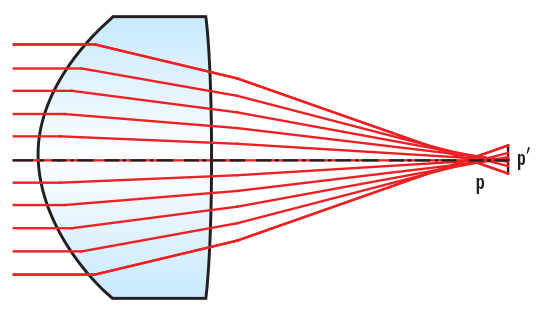
Figure 1: Spherical Aberration in a Single Positive Lens

igure 2.1: Transverse Chromatic Aberration of a Single Positive Lens

Figure 2.2: Longitudinal Chromatic Aberration of a Single Positive Lens
Chromatic aberration results from material dispersion. Because different colors of light refract by different amounts, an image point formed by light of one color does not coincide with the corresponding image point formed by light of a different color (Figures 2.1 and 2.2).
Important Equations
Spherical aberration is typically eliminated by substituting an aspherical surface for the more common spherical surface. The surface profile (sag) is given by Equation 1:

Where
Z = sag of surface parallel to the optical axis
s = radial distance from the optical axis
C = curvature, inverse of radius
k = conic constant
A4, A6, A8 = 4th, 6th, 8th… order aspheric terms
However, this does not correct chromatic aberration. Therefore, for a monochromatic light source, the aspheric surface will provide diffraction limited focusing at a single wavelength, but will suffer a large spot size over a broader wavelength.
A diffractive surface will correct the spherical aberration, as shown in Equation 2.

Where
Y = radial position from center of lens (for instance, if 0 is the center of the lens, 12.5mm will be the edge of a 25mm diameter lens, etc.)
nd = index of refraction of the material at 587.6nm
Step Height = λ/nd-1
λ = the wavelength of interest
By combining the two features onto a single element, a component that eliminates both chromatic and spherical aberration is created. That surface is described simply as the sum of the Zasph and Zdiff coefficients.
For tips on modeling diffractives in Zemax and Code V, visit the Optics Realm blog.
Customer Benefits
Optical designers often need to focus light at very short distances, or collect and collimate as much light as possible from very divergent light sources. Basic optical principles dictate that a high numerical aperture optical lens is required for either of these scenarios. A high numerical aperture optical lens will typically have a focal length equal to or shorter than the clear aperture of the optical system, allowing the designer to maintain as compact of an optical train as possible.
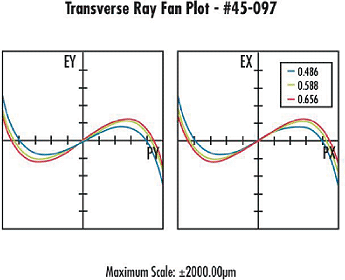
For example, an optical designer has multiple options for achieving a focal length that is equal to his clear aperture (a scenario known as an F/1 lens, or a lens with a numerical aperture of 0.50). The simplest option is to use a standard plano-convex lens, available from a number of distributors. Spot diagram, chromatic focal shift graph, polychromatic diffraction MTF, and transverse ray fan plot for the wavelength range of 486 - 656nm are provided for #45-097 25mm Diameter x 25mm FL PCX lens.
PCX Lens
Figure 3.1: Spot Diagram for #45-097 25mm Dia. x 25mm FL PCX Lens |
Figure 3.2: Chromatic Focal Shift Graph for #45-097 25mm Dia. x 25mm FL PCX Lens |
Figure 3.3: Polychromatic Diffraction MTF Graph for #45-097 25mm Dia. x 25mm FL PCX Lens |
Figure 3.4: Transverse Ray Fan Plot for #45-097 25mm Dia. x 25mm FL PCX Lens |
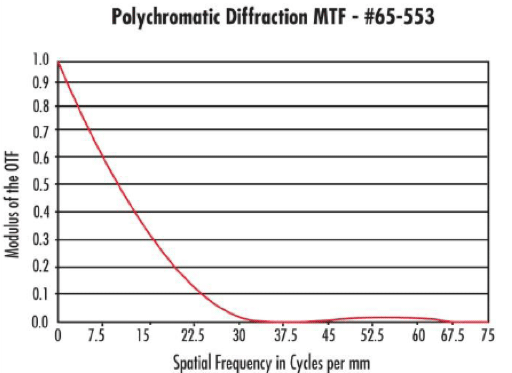
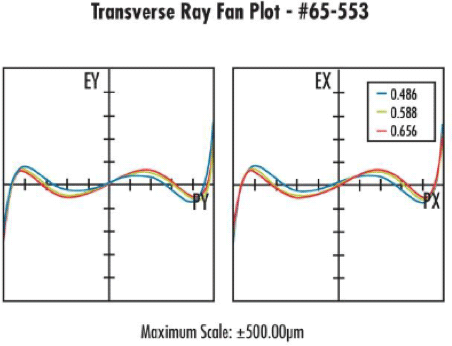
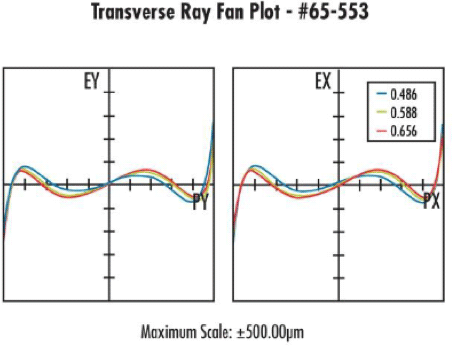
For improved performance, the optical designer could consider an achromatic lens of the same form factor, for example #65-553 25mm Diameter x 25mm Focal Length Achromatic Lens. Again, the same characteristics are shown over the same wavelength range. A 74% decrease in spot size with a 73% decrease in chromatic focal shift can be seen, yielding an MTF of 13 lp/mm at 40% contrast, a substantial gain versus the aforementioned singlet lens.
Figure 4.1: pot Diagram for #65-553 25mm Dia. x 25mm FL Achromatic Lens |
Figure 4.2: Chromatic Focal Shift Graph for #65-553 25mm Dia. x 25mm FL Achromatic Lens |
Figure 4.3: Polychromatic Diffraction MTF Graph for #65-553 25mm Dia. x 25mm FL Achromatic Lens |
Figure 4.4: Transverse Ray Fan Plot for #65-553 25mm Dia. x 25mm FL Achromatic Lens |
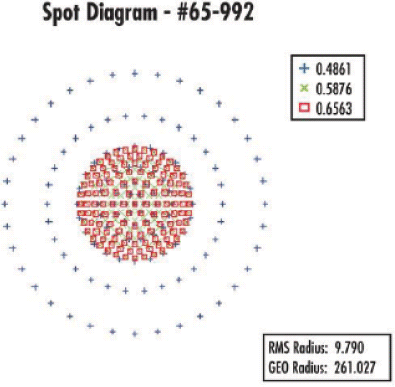
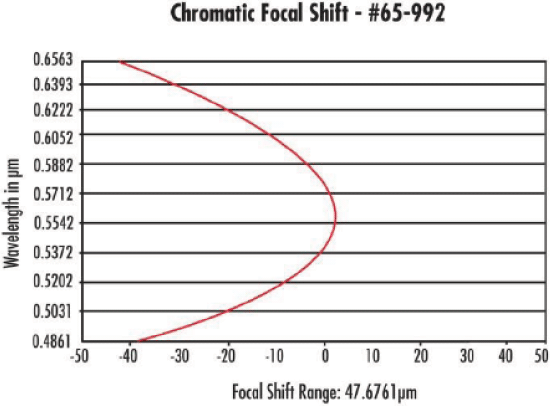
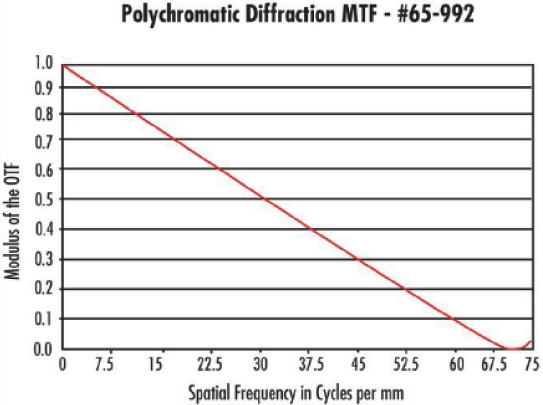
For maximum performance, the optical designer should choose a plastic hybrid aspheric lens. In this scenario, the exact same form factor and wavelength range are used, this time with #65-992 25mm Diameter x 25mm FL Hybrid Aspheric Lens. As shown, this lens provides diffraction limited focusing performance, yielding the optimum performance for the designer.
Plastic Hybrid Lens
Figure 5.1: Spot Diagram for #65-992 25mm Dia. x 25mm FL Hybrid Aspheric Lens |
Figure 5.2: Chromatic Focal Shift Graph for #65-992 25mm Dia. x 25mm FL Hybrid Aspheric Lens |
Figure 5.3: Polychromatic Diffraction MTF Graph for #65-992 25mm Dia. x 25mm FL Hybrid Aspheric Lens |
Figure 5.4: Transverse Ray Fan Plot for #65-992 25mm Dia. x 25mm FL Hybrid Aspheric Lens |
Comparing the spot diagrams, chromatic focal shift graphs, polychromatic diffraction MTFs, and transverse ray fan plots of a plano-convex (PCX) lens, achromatic lens, and hybrid aspheric lens, it is easy to see the advantages of using plastic hybrid aspheric lenses for achieving diffraction-limited focusing performance at high numerical apertures with broadband light sources.
Selection Guide
Edmund Optics® TECHSPEC® Plastic Aspheres and TECHSPEC® Plastic Hybrid Aspheres families are both manufactured utilizing Zeon Chemical’s Zeonex E48R material. Zeonex materials feature high transparency, low fluorescence, low birefrengence, low water absorption, and high heat and chemical resistance, making it a superior material vs. other commonly available plastics. Zeonex is a Cylco Olefin Polymer (COP) material.
Plastic Materials Selection Guide | ||||||
Property | Glass | Zeonex E48R | PMMA | Polycarbonate | Polystyrene | Arton® |
Transmission | Excellent | Excellent | Excellent | Good | Very Good | Excellent |
Low Refractive Index | Excellent | Excellent | Excellent | Poor | Poor | Good |
Low Birefringence | Excellent | Excellent | Excellent | Poor | Poor | Excellent |
Low Water Absorption | Excellent | Excellent | Poor | Good | Excellent | Excellent |
Impact Resistance | Poor | Good | Good | Excellent | Good | Excellent |
Moldability | Fair | Excellent | Good | Excellent | Excellent | Good |
Heat Resistance | Excellent | Good | Poor | Good | Poor | Very Good |
Coating Adhesion | Excellent | Good | Fair | Fair | Fair | Good |
版權所有 © 2026 江陰韻翔光電技術有限公司 備案號:蘇ICP備16003332號-1 技術支持:化工儀器網 管理登陸 GoogleSitemap